We measure what matters beneath the surface.
Industrial farming degraded 1/3 of global topsoil.
We help restore it with precision measurement.
What we can't see, we're losing.
The invisible crisis.
Soil Health Degradation
1980 - 2024
100%
80%
60%
40%
20%
0%
1980
1990
2000
2010
2020
2024
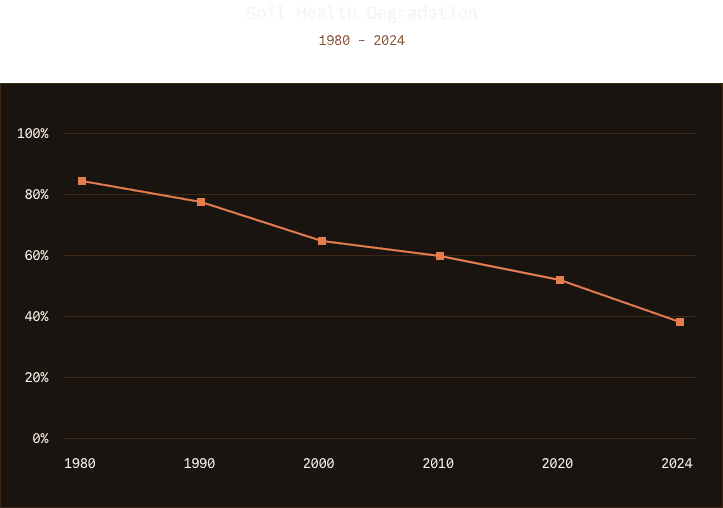
Scale of degradation:
Industrial agriculture has depleted one-third of the world's topsoil in just 40 years. The foundation of our food system is eroding faster than it can regenerate. What took millennia to build is disappearing in decades.
Why it matters:
Healthy soil isn't just dirt — it's a living ecosystem that sequesters carbon, filters water, and produces the food that feeds eight billion people. When soil degrades, we don't just lose farmland. We lose climate stability, food security, and ecosystem resilience.
The measurement gap:
Yet we've been operating blind. Farmers make decisions based on guesswork. Carbon markets trade credits with no ground truth. Regenerative practices spread without proof they work. The most critical resource for our survival has no reliable system of measurement.
Scale of degradation:
Industrial agriculture has depleted one-third of the world's topsoil in just 40 years. The foundation of our food system is eroding faster than it can regenerate. What took millennia to build is disappearing in decades.
Why it matters:
Healthy soil isn't just dirt — it's a living ecosystem that sequesters carbon, filters water, and produces the food that feeds eight billion people. When soil degrades, we don't just lose farmland. We lose climate stability, food security, and ecosystem resilience.
The measurement gap:
Yet we've been operating blind. Farmers make decisions based on guesswork. Carbon markets trade credits with no ground truth. Regenerative practices spread without proof they work. The most critical resource for our survival has no reliable system of measurement.
The invisible must become visible.
You can't restore
what you can't measure.
0
400
0
33%
Of global topsoil degraded in 40 years.
$400B
Annual cost of soil degradation globally.
95%
Of our food comes from soil.
0
Standardized systems for soil health verification.
0
400
0
33%
Of global topsoil degraded in 40 years.
$400B
Annual cost of soil degradation globally.
95%
Of our food comes from soil.
0
Standardized systems for soil health verification.
0
400
0
33%
Of global topsoil degraded in 40 years.
$400B
Annual cost of soil degradation globally.
95%
Of our food comes from soil.
0
Standardized systems for soil health verification.
How we measure.
Layer by layer, from orbit to soil.
TerraScan doesn't rely on single data sources. We synthesize information across five measurement layers — from satellite imagery capturing landscape patterns to soil samples revealing microbial activity. Each layer validates and enriches the others, creating a complete picture of soil health that no single method could achieve alone.
01
SATELLITE DATA
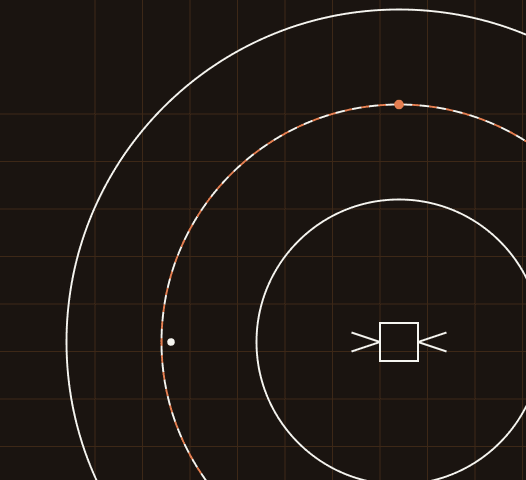
Multispectral satellites track vegetation health, moisture patterns, and land use changes across entire regions — updated every 3-5 days. We analyze NDVI, thermal signatures, and terrain elevation to identify degradation patterns before they're visible to the naked eye.
01
SATELLITE DATA
Multispectral satellites track vegetation health, moisture patterns, and land use changes across entire regions — updated every 3-5 days. We analyze NDVI, thermal signatures, and terrain elevation to identify degradation patterns before they're visible to the naked eye.
02
DRONE SURVEYS
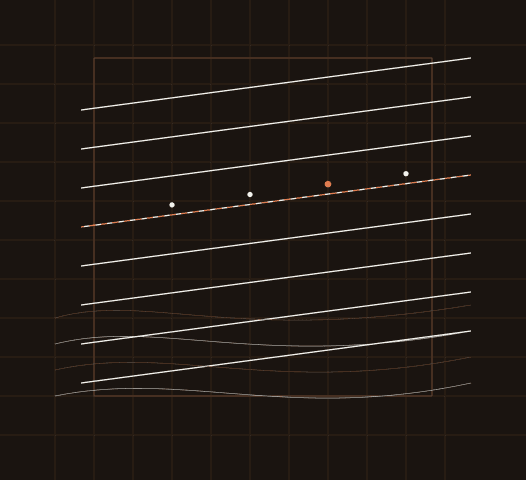
Commercial drones capture RGB, multispectral, and thermal imagery at 2cm resolution — details satellite imagery can't match. Flight paths are optimized to reveal erosion patterns, compaction zones, and irrigation inefficiencies across thousands of acres in hours.
02
DRONE SURVEYS
Commercial drones capture RGB, multispectral, and thermal imagery at 2cm resolution — details satellite imagery can't match. Flight paths are optimized to reveal erosion patterns, compaction zones, and irrigation inefficiencies across thousands of acres in hours.
03
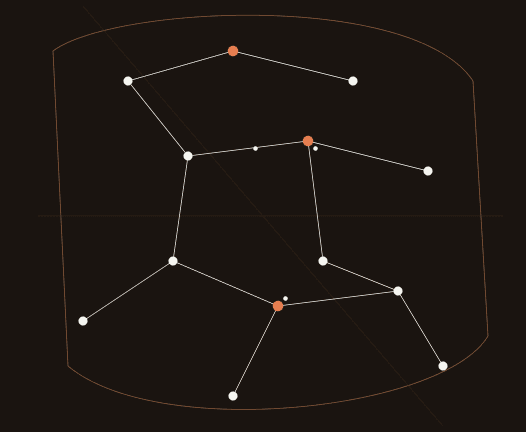
GROUND SENSORS
Wireless sensor arrays transmit soil moisture, temperature, pH, electrical conductivity, and nutrient data hourly — revealing how conditions change across seasons and weather events. Continuous streams validate remote sensing predictions and trigger alerts when thresholds are crossed.
03
GROUND SENSORS
Wireless sensor arrays transmit soil moisture, temperature, pH, electrical conductivity, and nutrient data hourly — revealing how conditions change across seasons and weather events. Continuous streams validate remote sensing predictions and trigger alerts when thresholds are crossed.
04
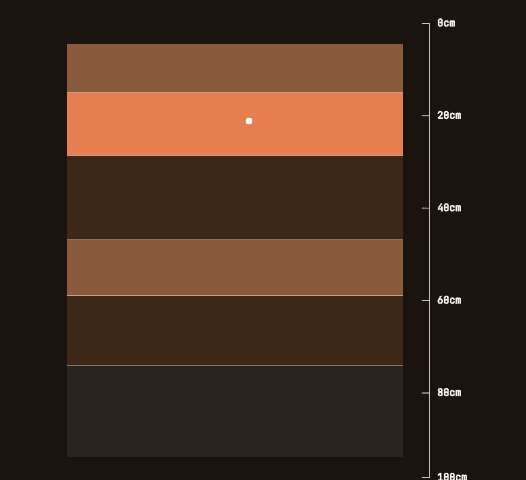
SOIL SAMPLES
Laboratory analysis quantifies what sensors and satellites can't: carbon content, nutrient levels, microbial diversity, and physical structure. Ground truth data validates our models with 94% accuracy and calibrates predictions for specific soil types and climates.
04
SOIL SAMPLES
Laboratory analysis quantifies what sensors and satellites can't: carbon content, nutrient levels, microbial diversity, and physical structure. Ground truth data validates our models with 94% accuracy and calibrates predictions for specific soil types and climates.
05
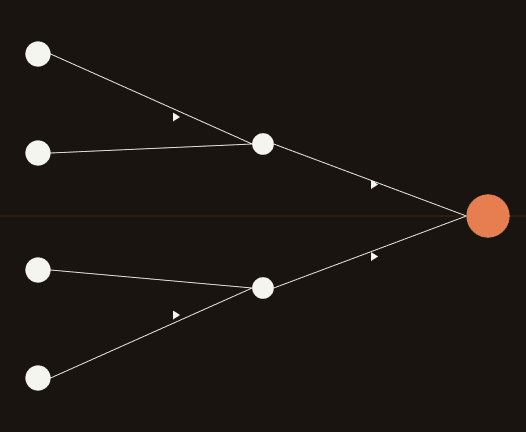
PREDICTIVE MODELS
Neural networks trained on millions of data points forecast carbon sequestration potential, erosion risk, optimal crop rotation strategies, and regeneration timelines — updating continuously as new measurements arrive, improving accuracy with every field season.
05
PREDICTIVE MODELS
Neural networks trained on millions of data points forecast carbon sequestration potential, erosion risk, optimal crop rotation strategies, and regeneration timelines — updating continuously as new measurements arrive, improving accuracy with every field season.
What we've measured.
01/04
2.4M+
Hectares monitored
02/04
94%
Model accuracy
03/04
847
Farms assessed
04/04
3.2M
Carbon credits verified
01/04
2.4M+
Hectares monitored
02/04
94%
Model accuracy
03/04
847
Farms assessed
04/04
3.2M
Carbon credits verified
The science behind the data.
Our measurement framework combines peer-reviewed soil science with independent laboratory validation. Built to meet the standards of global carbon markets and regenerative agriculture research.
12 soil types
Peer-Reviewed Science
Our protocols are grounded in published soil science and aligned with IPCC carbon accounting standards. Every method is documented, reproducible, and open to scrutiny.
12 soil types
Peer-Reviewed Science
Our protocols are grounded in published soil science and aligned with IPCC carbon accounting standards. Every method is documented, reproducible, and open to scrutiny.
4 climate zones
Third-Party Validation
All soil carbon claims are verified by independent accredited laboratories. Results are cross-referenced against physical samples to ensure predictions reflect ground reality.
4 climate zones
Third-Party Validation
All soil carbon claims are verified by independent accredited laboratories. Results are cross-referenced against physical samples to ensure predictions reflect ground reality.
94% accuracy
Open Data Standards
TerraScan data is compatible with Verra, Gold Standard, and CAR carbon frameworks — ensuring seamless integration with global carbon markets and agricultural reporting systems.
94% accuracy
Open Data Standards
TerraScan data is compatible with Verra, Gold Standard, and CAR carbon frameworks — ensuring seamless integration with global carbon markets and agricultural reporting systems.